


Building a company or a product or anything meaningful needs the magic and the madness of one individual. It's not a process game but a game of bets that only a few select people make to move something from 0 to 1. This is accepted wisdom in the business world. Almost everyone agrees that moving something from 1 to 10 needs setting up of repeatable processes that scale over time
When the maverick founder continues to lead the process building stage, processes are built around them, their strengths and how they behave. These are the cult stories that go into the folklore like the ones around Steve jobs picking up the tiles of the floor in the Apple showroom
Every now and then we keep hearing these stories having a protagonist makes for good pizzaz in these stories. But what happens when these protagonists aren't around. There are many examples where this becomes a big bottleneck, Rajeev Jain with Bajaj finance in India with their current transition is the latest one that I can think of. Jain's successor who was groomed for years didn't last a full year and Rajeev had to take the reins back. These mavericks are the conduits for greatness but they can be the bottlenecks for the greatness to become a protocol
Jobs is idolized for the charismatic builder that he is but very few people realize that he actively setup Apple University to transfer his ideologies into principles. His successor ran a 15 year long incredibly successful trillion dollar behemoth with the identity of Apple intact. Principles are the personification of the maverick into soul of organization. Protocols are the principles that have been forced to survive in the wild
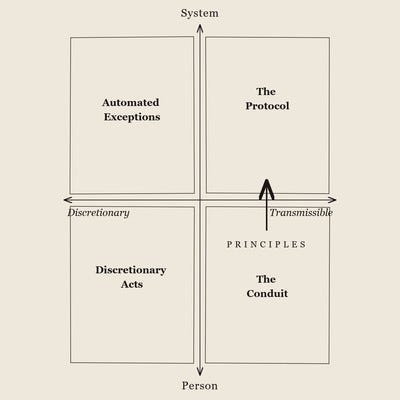
It doesn't have to be the same person doing both the maverick role and the protocol builder role. Fred Turner was the scaler of Ray Krocs vision for McDonald's. While Ray Kroc was the maverick who believed McDonald's potential, Fred Turner was the one who figured a playbook that can scale and be commercially viable across countries and continents
Military has been trying to do this for centuries, they run on commanders intent rather than orders so that a commander going down isn't the bottleneck for the mission being accomplished. Commanders intent is the principle on which protocols are realized on the ground. Maybe these are the reasons while a lot of successful founders try to instill their identities into principles which are infused deep enough for long enough to become protocols- Amazon, IKEA
While what happens at an organization level is still controlled at least to some extent by the boards. Nobody does that for functions within an organization. Functions are similar to regiments in Military but we rarely see them work like one. Regiments have souls, stories, rituals and processes that go beyond individuals and are distinct enough and survive decades/centuries. No one forces functions to think and work like regiments, no one will, some one will have to
When functions/units within an organization build a process like these they can create ripple effects that can at times stretch beyond the company itself like military regiments that can have their own identity. Skunk Works within Lockheed Martin is a great example of how one team can genuinely build something incredible for decades. What's not often talked about is how Skunk Works inspired Lockheed Martin Space Company to build something even more incredible themselves. The protocols of Skunk Works served in a way that a different team run by different people could model theirs and probably succeed more than Skunk Works.
Now, if setting this up is important, how do we get there at whatever level we are operating at. History doesn't suggest that there is a defined method for getting there. Everyone who did found their own way. What is constant is everyone being paranoid about creating something that lasts beyond them.
Does this work if I'm not there for a week or a year or forever is the question every leader at every level should think and act on. If you can't answer yes, you're still the conduit. Rajeev Jain still is.