


Most retail businesses die from distraction, not from lack of ideas. They debate new launches, visibility strategies, scheme structures, channel conflicts. All of it feels important. Most of it might not matter.
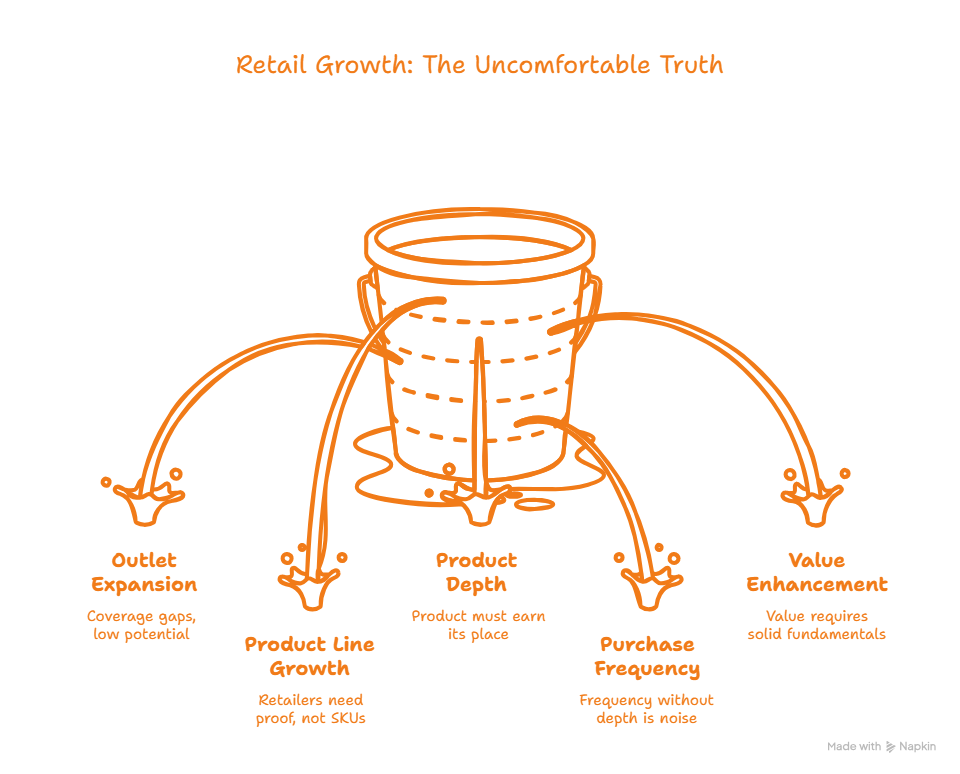
Because when you strip away the noise, growth in retail comes from exactly five levers. You either work them systematically, or you don’t grow. Everything else is commentary
You either sell to more outlets,
or you sell more things,
or you sell more of each thing,
or you sell more often,
or you earn better value each time.
Most teams know this framework intellectually. Few are honest about where they’re actually failing. At some point, every retail business hits a wall and starts saying things like “the market is saturated” or “growth is slowing”. What they usually mean is: the easy levers are exhausted, and the uncomfortable ones remain.
Adding more outlets means confronting coverage gaps we’ve learned to live with, retailers we never quite won over. Markets we claim are “low potential” because winning them would require real effort. Once outlets exist, pushing more things is the next test. Retailers don’t want more SKUs by default, they want proof that each one earns it’s place on the shelf. If a second or third line doesn’t come in, it’s rarely a space problem, it’s a belief problem. Driving more of each thing is even more uncomfortable. Depth exposes whether your product deserves to sit deeper on the shelf. Not whether it can be pushed, but whether it earns its place through pull.
Only after this does more often start to matter. Frequency without depth is noise, it’s activity without momentum. If a retailer buys only when incentivized, that’s not habit, it’s dependency. And finally, better value each time. This is the hardest lever of all. Price increases and premiumization only work when everything before it is already solid. True value growth comes when a retailer believes selling your product improves their business, not just your margins. That belief isn’t negotiated, it’s earned
What’s interesting is how often teams try to grow by pulling side levers instead.
We redesign packaging.
We tweak claims.
We introduce variants no one asked for.
We change distributors.
All of it feels like movement.
If none of this results in outlets growing, lines expanding, depth deepening, frequency improving, value increasing, the math doesn’t change.
Retail is brutally honest. It reflects back exactly how useful you are to the person on the other side of the counter. The best retail businesses I’ve seen are obsessively boring about this. No grand narratives. Just quiet consistency.
They understand that growth doesn’t come from trying something new every quarter. It comes from doing the same fundamentals better than everyone else, for longer than most teams have the patience for.
Every time a retail business says “we need a new growth strategy”, it’s worth asking a simpler question: Which of the levers are we actually avoiding? Because in retail, growth is rarely mysterious. It’s usually just inconvenient. And the math never lies.