


Efficiency is almost always framed as a virtue. It isn’t. Do more with less. Faster, cheaper, cleaner. Rarely do we talk about what it quietly trades away. Most companies don’t fail because they’re inefficient. They fail because they’re too efficient.. And once you notice this, you start seeing it everywhere.
Take IndiGo. For years, they were the gold standard of operational efficiency. Tight turnarounds. High aircraft utilization. Lean staffing. Everything optimized to keep costs low and planes flying. It worked. Until it didn’t.
Flights got cancelled. Schedules fell apart. The very efficiency that made the model successful ended up destabilizing it. They didn’t lose efficiency first. They lost the human connection with their pilots and eventually their consumers.
What usually gets missed in these stories is “Essence”, the thing that made efficiency worth pursuing in the first place. Every business has one, whether it names it or not. It’s the thing that, if damaged, makes all efficiency meaningless. For an airline, it isn’t just low cost. It’s safety, reliability, and trust delivered by people who aren’t permanently operating at the edge.
Essence isn’t soft. It’s structural. It’s what allows efficiency to compound instead of collapse.
The Systemic Trap
What’s really happening here is an equilibrium problem, but not the comforting kind
In game theory, equilibrium usually means a stable state where no player benefits from changing strategy. But there’s a darker version: a point where every player makes an individually rational decision that collectively destroys value.
Look at airlines. Indigo optimize operations. SpiceJet has to match them or lose competitiveness. Air India follows. Each airline is making the locally optimal decision: cutting slack, maximizing utilization, reducing buffer. No one wants to be seen “wasting money” on margin in the system. But collectively, they push past the point where efficiency serves them.
Industry-wide essence of reliability, safety culture, operational resilience degrades for everyone. Everyone can see it happening. Game theory makes it nearly impossible for anyone to stop.
You see the same pattern in FMCG.
Every major player has converged on essentially the same model. Frontline sale people on third-party or distributor payroll. The entire system optimized for cost efficiency and distribution reach. HUL optimizes their structure. ITC has to match or look bloated. Nestlé follows. Britannia follows. Each company makes the locally optimal decision. Collectively, industry locks into a structure where no one can afford to invest differently in frontline talent. The frontline sales guy who moves from HUL to ITC to Marico isn’t climbing a ladder. He’s trapped in a system where every company has converged on the same efficient structure that guarantees stagnation at the bottom.
Growth then comes from distribution expansion and macro tailwinds. Real consumer insights and product innovation gets outsourced to startups.
Efficiency wins. Essence thins out.
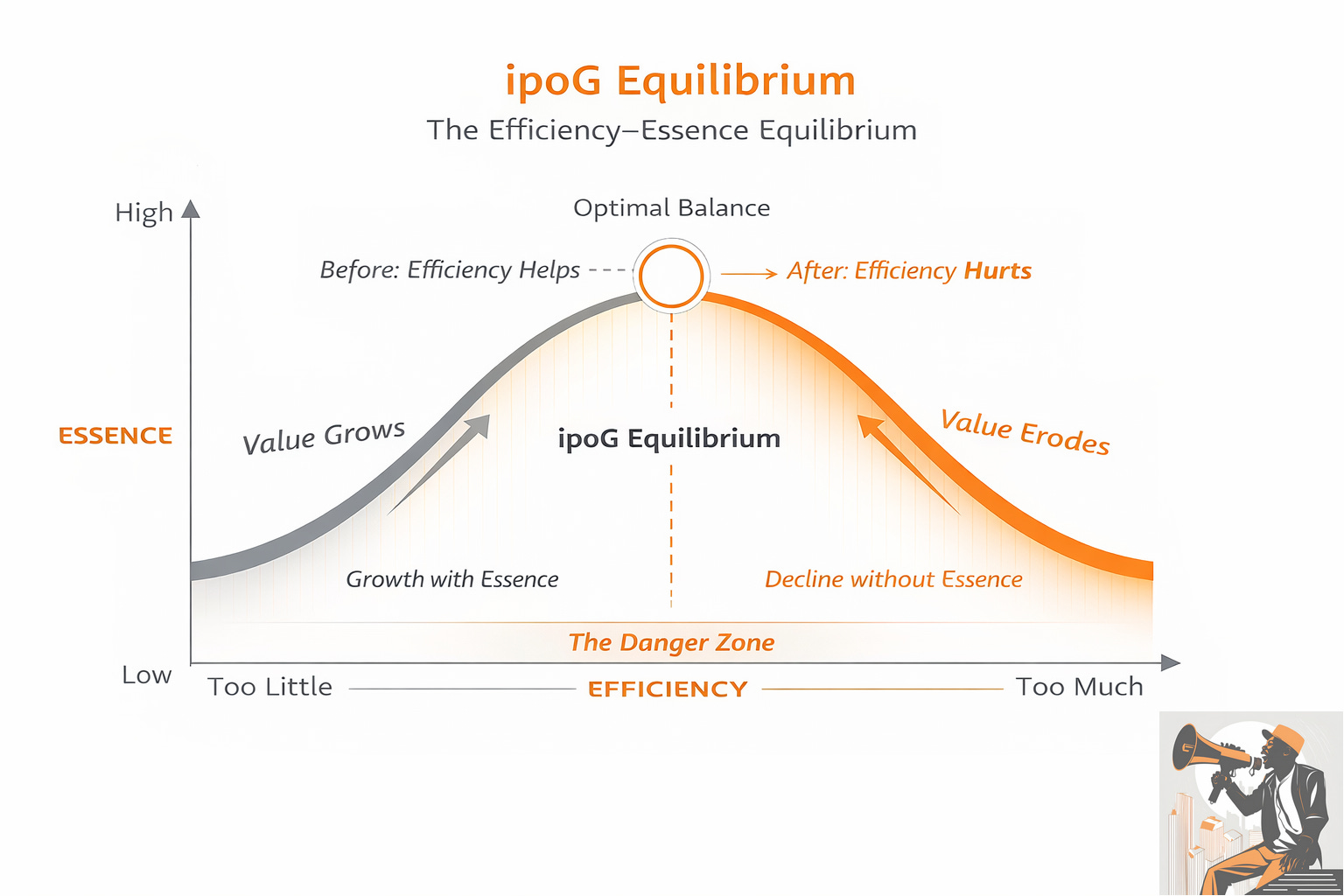
What’s really happening here is an equilibrium problem. Like in game theory, there’s a point where pushing further stops helping. A balance where efficiency and essence coexist.
I call this the ipoG Equilibrium.
It’s the point where efficiency and essence are in balance. Before it, efficiency helps. After it, efficiency starts hollowing the system out even if the numbers still look good. The problem is you don’t feel this point when you cross it. Efficiency is visible. It lives on dashboards. Essence isn’t.
You only see essence through second-order signals. People stop recommending you. Your best operators disengage. Customers stay, but without affection. By the time someone says “this place isn’t what it used to be”, you’ve usually crossed the equilibrium already.
What makes this worse is that it behaves like a trap. If everyone in an industry keeps optimizing, no one wants to be the first to stop. Each decision looks rational in isolation. Collectively, the system degrades.
Sometimes the right decision is to stop optimizing. Not because inefficiency is virtuous. But because essence needs margin.
Margin for judgment.
Margin for recovery.
Margin for doing the right thing when the playbook doesn’t apply.
If you’re running a business or a team, the real question isn’t “how do we become more efficient?” It’s:
where is our ipoG Equilibrium and what breaks if we push past it?
Because efficiency without essence doesn’t scale. It just fails, quietly, slowly and then all at once.